Rebranding MTV

Project Date: Spring 2021
What happened?


MTV's Brand History
MTV's Brand History
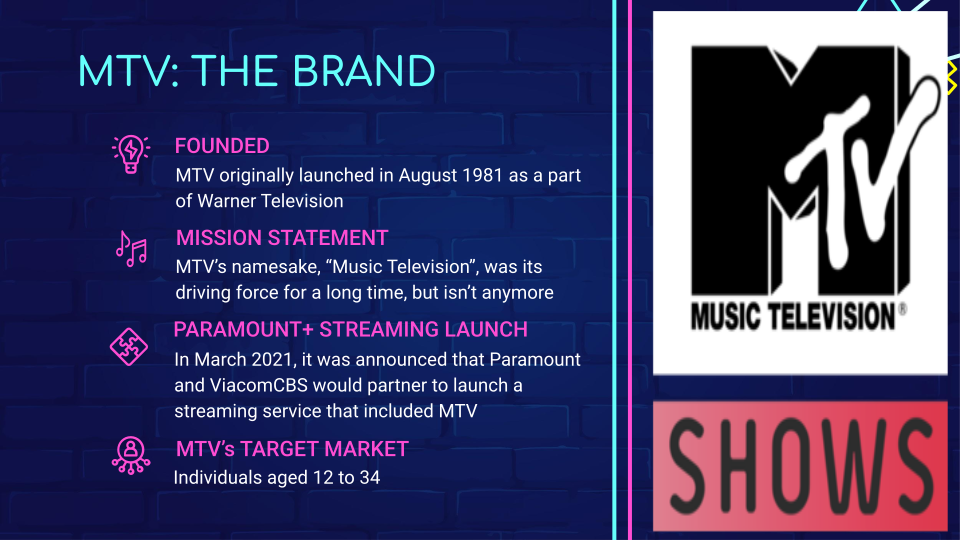
MTV originally launched almost 40 years ago in August of 1981 as a subsidiary of Warner’s Television operations and now currently operates underneath ViacomCBS.
The original brand purpose and MTV’s namesake stood for “music television” intent on playing music videos 24/7 with that mission statement being explicitly written underneath its brand’s original logo. From exclusive artist performances in their MTV Unplugged series, breaking music trends presented daily on TRL, or even just morning music video streams, MTV and music were one and the same. Since then, it seems as if MTV’s connection to music is thinly held together by the MTV Video Music Awards as the network has leaned heavily into dramatic reality television and strayed far away from music or original programming.
This past March, ViacomCBS partnered with Paramount to launch their own entry in the streaming rivals in Paramount+ that serves as a bundled package of CBS, CBS Sports, Nickelodeon, VH1, BET, The Paramount Network, Comedy Central, MTV, and more. Our branding strategy focuses much on the way that a transition to streaming allows MTV an opportunity to re-establish its value proposition to viewers.
MTV’s current Target Market is viewers aged 12 to 34 with the majority of their viewers falling in the 18-49 viewership bracket. Individuals aged 18-29 making up a third of their primetime viewers and individuals aged 30-49 making up just under a third of those same primetime viewers. To MTV’s benefit, the deep back catalog of content and intellectual property allows the brand to enter into streaming with programming ready for MTV viewers of the past and MTV viewers of the present.
MTV's Brand Associations
MTV's Brand Associations
To align ourselves and our assessment of where MTV’s brand equity stands right now, we decided to take a look at what men and women in our networks between the ages of 18 and 30 thought of the brand when unprompted via association maps. All participants had previous connections with the brand, but as we gained reports, it became evident many were no longer users. Through the use of the associative maps, we were able to identify the valence the user had towards the brand, the level of depth they knew about the brand, and what their biggest identifying attributes of the brand were. The maps that were completed gave insight on why the users were still connected or had disconnected with the brand. Once all the maps were collected, our goal was to compile the responses into a heat map and consumer profile to assess the brand equity based on the strongest associations we came up with.
From the data, we can see that the most common association with MTV is music. However, we noticed a contradiction in the sense that the other prominent mentions had nothing to do with music. This contributed to many disconnected users’ dissociation from the brand. Currently, most of the survey respondents associate MTV with the television shows that they produce. Although many of the shows were liked among some groups, many expressed in their maps that they were annoying, superficial, and no longer popular. The association of these shows overpowered the brand’s original purpose of sharing music leading to a disconnect when users would think to go to MTV for music but were overwhelmed with reality television instead.
All of the people we reached out to survey were familiar with the brand, but many could not produce maps that showed strong associations. People were able to produce specific offerings or programs MTV had to offer, but lacked in showing strength or resonance with the brand. While we would have liked to see the brand linked to things like memories, positive emotions, or events rooted in tradition, we only saw them as a reproduction of facts known about the brand. We also saw that people did not feel passionately about the brand, because the average valence towards the brand was fairly neutral across each map (skewing slightly negative from male respondents).

Market Challenges
Market Challenges
- Over the last 5 years, MTV’s main audience is between the age 18-49 (Forbes & Statista)
- 12-34 is MTV’s Target Market (NY Times, Forbes, Business Insider, & Encyclopedia)
- This generation is more acute to realism driven through early exposure to technology which has allowed for an information overload vs MTV’s older generation’s who were more likely to believe anything was possible
- Change in preference has impacted viewer’s taste and forced MTV to create a new algorithm of science vs art
- This generation is more acute to realism driven through early exposure to technology which has allowed for an information overload vs MTV’s older generation’s who were more likely to believe anything was possible
- 18-29 makes up a third of its prime time viewership (Forbes & Statista)
- Generation Z & Young Millenials
- Generation Z & Young Millenials
- 30-49 is just under a third of the network’s viewers (Forbes & Statista)
- Older Millennials who grew up during MTV’s “prime” before viewership started declining in 2013 (Forbes)
- Older Millennials who grew up during MTV’s “prime” before viewership started declining in 2013 (Forbes)
Streaming and Consumer Decision Making
Streaming and Consumer Decision Making
- Video streaming arose as a replacement for cable, so in an effort to cord-cut, many are making the decision amongst a few streaming services as opposed to subscribing to all of them (which would ultimately lead to a price comparative to cable).
- Content is king. Netflix’s early streaming strategy was to consolidate other intellectual property as it developed its brand for original content. Intellectual property rights are now safe-guarded, so consolidation efforts are being made by major players in the market to pitch to prospective customers a vast amount of well-known content.
- Major players: Netflix, Hulu, HBO (Max now), Amazon Prime Video, & Disney+
- Factors in consumer decision making include:
- Cost, Ease of Use, Pre-Existing Subscriptions, Social Trends
The COVID Factor
The COVID Factor
Market Behavior
With quarantine, people are consuming media at a rate higher than ever. Data has shown that consumers watch approximately 8 more hours of total shows a week with an increased viewing rate of 40% during late night hours. However, according to a Nielsen study, only about 90 minutes of that time was spent on traditional TV services, which is largely credited to News channels. Therefore, the majority of media consumption can be accredited to streaming platforms, YouTube and social media. 66% of consumers report that over half of their media consumption is on demand, opposed to live broadcasts in 2020.
The market has also shown increased price sensitivity as a result of the unstable job market. In an analysis done by the RBC Wealth Management group, if consumers were to change to a combination of premium subscriptions to 5 streaming services over an average priced cable service, they would spend 59% less on media. As a result, the downfall of cable is only expected to increase even past the quarantine.
MTV Behavior
In response to the pandemic viewing habits, MTV has been transferring live events to virtual, such as the MTV Video Music Awards. They have also heavily relied upon their blogging platform to reach consumers with news updates, coronavirus industry information and pandemic advice. They have increased both monetary and advice driven social responsibility efforts to aid in the fight against coronavirus. The most notable being the MTV Shuga Alone 60-part mini-series to raise awareness of the global fight to flatten the COVID-19 curve.
Streaming Partnership
MTV has also noticed the trend in the transition to streaming services and has just announced their partnership with the new streaming platform Paramount Plus, coming out on March 4th. This partnership extends their brand offering past their current services to include more diverse content and movies. ViacomCBS’ rebrand of CBS All-Access includes cable channels such as Nickelodeon, MTV, BET, Comedy Central, and more. Consistent to the new needs of the market, this streaming service will be competitively priced at $5.99 a month or $9.99 for premium.
MTV's Brand Equity
MTV's Brand Equity
In our research, we found that many of the negative associations were derivative of a sense of detachment from the brand over time as the content that they originally gravitated toward faded out altogether. As a result, so did their viewership. Rather than respond to this call to action, MTV pushed back. They didn’t create content that promoted longevity. When shows ended, they just ended. Their shows that had substance got phased out, and shows that replaced them were often ones that were perceived as annoying.
This is a platform that formerly was on the zeitgeist of everything pop and youth culture related having the opportunity to be what YouTube ultimately became--a one-stop shop for any content you’d want including music and entertainment, but MTV didn’t understand at the time. As competition for their offerings increased, they lost their unique value proposition. Making matters worse, MTV is also very late to streaming (and in the age of cable-cutting, this is where young people are predominantly consuming their content), so not only has their content become more difficult to view over time, they’ve never had less content that aligned with the brand’s golden era of viewership.
Our current rebranding strategy merges what worked in the past and attempts to both recapture that lost audience in hopes of getting them to migrate back to the platform with restored faith and confidence in their investment of former content values while also attempting to retain its current viewers in hopes of not losing them, too, in the same way that previous generations have been neglected by the service through a reinvisioned content strategy plan as MTV transitions onto Paramount+.

MTV's Rebrand
MTV's Rebrand
As we discussed, MTV used to be the go to source for what was trendy in music and pop culture. However, somewhere along the way, they lost their unique value proposition. With the rise of YouTube and social media, consumers were now able to access music and pop culture information through more convenient sources. We believe that MTV could have maintained it’s status, regardless of the competition, if they stuck with the trends. They were very late to adapting to the streaming system and lost their brand identity with leaning away from music and deep into reality television. As we saw with our association maps, everyone knew MTV, but many people were no longer users and their reputation was no longer primarily positive. That being said, we do believe that MTV can be rebranded in a way that brings them back to the forefront of entertainment.

Selected Works


